Health and Safety Policy for Flat Clearance Earls Court
 This Health and Safety policy sets out the principles, responsibilities and practical measures adopted by our flat clearance operation to reduce risk during every rubbish removal and apartment clearance activity. The policy applies to all staff, contractors and temporary workers engaged in flat clearance and waste removal services, and it complements existing legislative requirements without reproducing legal detail. Our aim is to protect people, property and the environment during every stage of a flat clearing or rubbish collection task.
Scope and Objectives
The scope covers routine and non-routine tasks including furniture lift-outs, debris sorting, scrap removal, and safe transportation of waste. Objectives are to prevent injury, minimise occupational hazards and ensure safe operation of vehicles and equipment used in our clearance company work. We emphasise safe waste handling for general household rubbish, bulky waste and recyclable materials and maintain procedures for identifying potentially hazardous items. The policy promotes a culture of continual improvement: regular risk assessments, toolbox talks and recorded monitoring. All employees involved in flat clearance services must follow specified safe systems of work for rubbish removal, including route planning, safe stacking and securing of loads, plus clear guidance when disposing of mixed waste. Clear roles and safe practices reduce incidents and maintain service quality.
Responsibilities: Senior management has overall responsibility for policy implementation and for ensuring sufficient resources for safety. Supervisors and site leads are responsible for site-specific risk assessments and daily checks. Operatives must comply with instructions, wear issued personal protective equipment (PPE) and report hazards. Managers will ensure training in manual handling, safe use of trolleys and lifting aids, and safe operation of vehicles used for rubbish collection and waste transfer.
 Risk assessment and control measures form the core of our approach. Before every job, operatives must complete a simple, recorded assessment covering manual handling hazards, fragile flooring, access limitations, sharps or chemical concerns and traffic interaction when loading vehicles. Mitigations include use of mechanical aids, two-person lifts for heavy items, edge protection on stairways, and exclusion zones for public safety. Control measures are reviewed after every incident or near-miss.
Training & competence: All personnel receive induction training specific to flat clearance and rubbish removal work, including manual handling, PPE usage, hazardous materials awareness and emergency procedures. Competence is verified through practical observation and periodic refresher training. Contractors and temporary staff must demonstrate suitable skills before authorisation to work on clearance tasks. Records of training are maintained and audited.
Equipment and vehicles: Vehicles and tools used in our flat clearance operations are inspected and maintained on a planned schedule. Safe load limits are observed and loads secured to prevent movement during transport. Operatives are trained in vehicle safety, reversing protocols and use of ramps or tail-lifts. For rubbish collection that includes bulky items, specialist lifting equipment may be used to reduce manual handling risk and protect property.
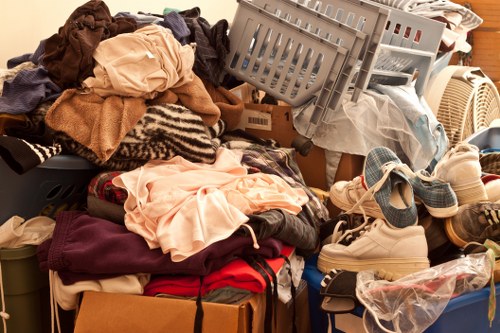 Incident reporting and emergency response: Any injury, spill or property damage arising from clearance work must be reported immediately and recorded. There is a clear procedure for first aid, safe containment of spills and notification of relevant authorities where hazardous materials are involved. Lessons learned are fed back into revised risk assessments and site-specific controls to prevent recurrence.
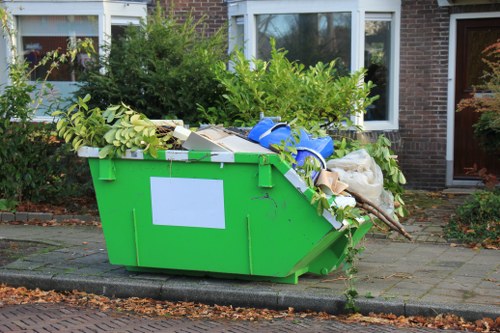 Safe waste sorting and disposal: Our teams follow segregation rules—separating recyclable items, general rubbish, electrical waste and any hazardous materials that require specialist removal. Items suspected of containing asbestos, contaminated liquids or certain batteries are treated as potentially dangerous and escalated to trained operatives with appropriate PPE and disposal routes. The flat clearing service emphasises minimising environmental impact and ensuring lawful waste transfer to authorised facilities.
Monitoring and review: The policy is monitored through workplace inspections, incident trend analysis and feedback from operative observations. Regular management reviews ensure the safe systems of work remain effective for clearance company activities, and adaptations are made for new waste types or operational changes. Performance indicators include incident frequency, completion of risk assessments and training currency.
Key elements summarized:
- Risk assessment before work starts
- Competent staff with job-specific training
- PPE and equipment maintained and used
- Incident reporting and continuous improvement